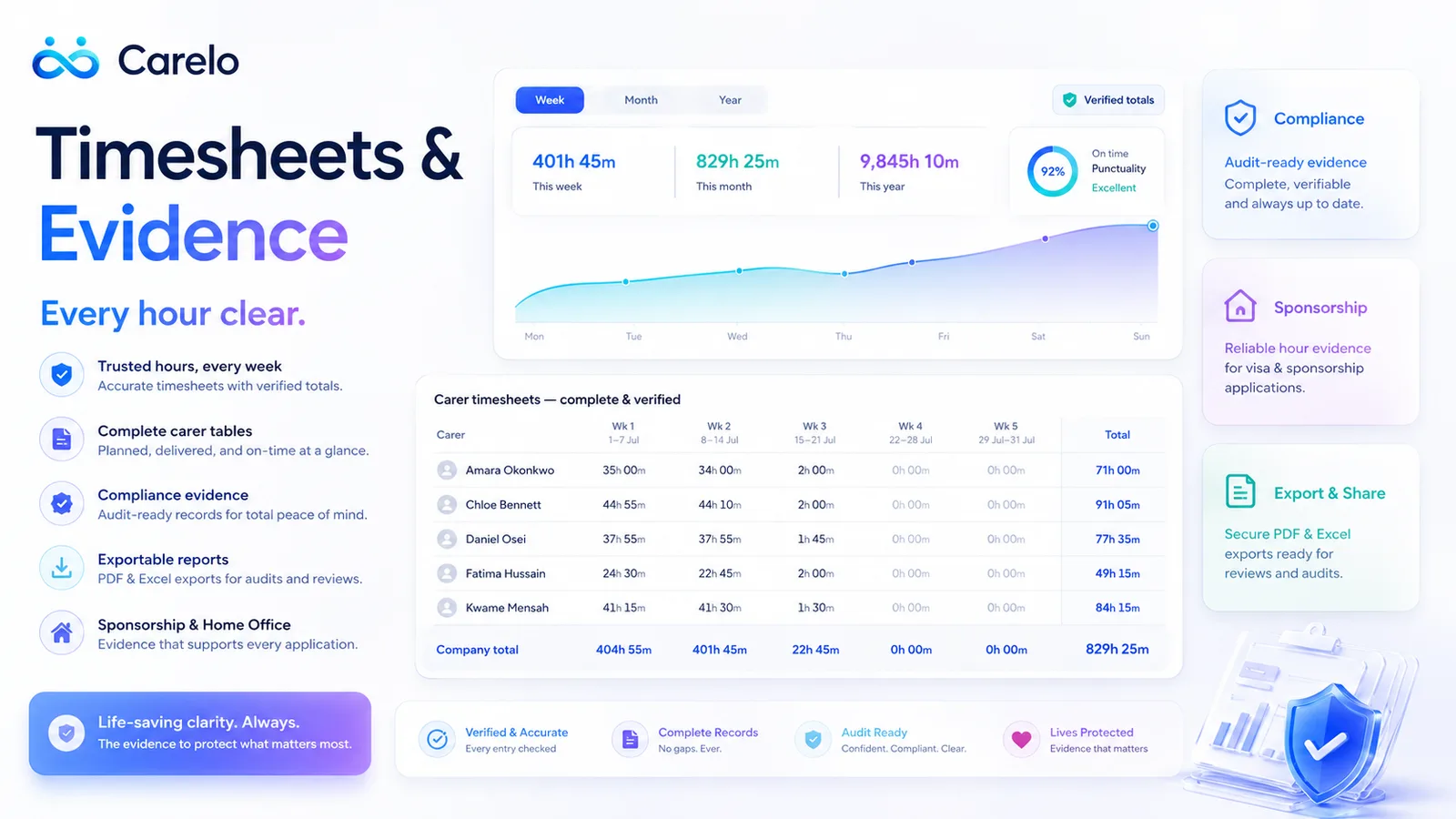
Every month a family employer has to answer one question with a number: how many hours did each carer work? The payroll depends on it, the council review checks it, holiday is earned from it, and minimum wage is measured against it. Most families answer it with a paper timesheet the carer fills in from memory and the family signs without checking. This page is about getting the number right with no effort, and being able to prove it.
The paper timesheet is filled in at the end of the week or the month, from memory, by the person being paid for the hours on it. Nobody is being dishonest; memory is simply poor at Tuesday mornings three weeks ago. Calls that ran short are rounded up, calls that ran long are forgotten, a swapped shift is written against the wrong name. The family signs because arguing feels unkind. The payroll service pays what is on the sheet.
Then the council review asks why the hours on the timesheets exceed the hours in the plan, or two carers have both claimed the same Saturday, and nobody can say what actually happened.
Minimum wage is per hour worked, not per month paid. If a PA is paid a flat weekly amount and the hours creep up, the hourly rate can drop below the legal minimum without anyone noticing. A record of real hours is the only protection.
Holiday builds from hours. A PA on variable hours earns holiday in proportion to the hours actually worked. Without the hours, the holiday figure is a guess, and guesses are what employment tribunals are made of.
Sleep-ins and waking nights are paid under different rules. Record which it was, with the times.
The council pays for the plan's hours. If the timesheets regularly show more, the review will ask who is paying for the difference. If they show fewer, it will ask whether the needs are being met.
Care providers solved this years ago. The carer taps the app on arrival and on leaving, and the hours are those two stamps. There is nothing to remember and nothing to round. A swapped shift is recorded against the carer who actually came, because they are the one who tapped. A short call is short. A long call is long, and the family sees it was long on the day, not at the end of the month.
Families were never offered this, so they kept the paper. The Personal plan is the provider system with the company parts removed, which is why the timesheet works the same way.
Check-in and check-out at your door. Each carer checks in when they arrive and out when they leave, in the Carelo app. The stamps carry the time and the location. No signal at your home? The stamps are kept on the phone with their original time and sent when the signal returns.
Hours this month, per carer. The hours come straight from the stamps. Open a carer and see their calls and hours for any period, call by call.
Timesheets that export. Export the period's timesheet for your payroll service in a few clicks. The hours it pays are the hours that were worked, and the council review sees the same figures.
Double-ups counted properly. When two carers attend together, each is paid for their own time on the call.
Holiday from the same hours. A PA asks for leave in the app, you see the gap it leaves in the rota before you approve, and the approved leave is recorded.
Carelo does not run payroll or calculate tax. It gives your payroll service the right hours.
The call stays open on your home page so you notice the same day. The time is then put right as a manual check, and the record shows it was a manual entry rather than a tap at the door, so it stays honest.
Yes, an iPhone or Android phone. The Carelo app is free, and the carer enters a one-time setup code to see only your loved one's calls.
You can, but the point is to stop. Once hours come from the door, the paper sheet only creates a second version of the truth.
Councils accept the same electronic records from care providers every day. Print or export the period and send it with the payroll reports.
The Personal plan is £30 a month per household, or £288 a year with 20% off, for up to three loved ones and fifteen carers. Fourteen days free, no VAT added, cancel any time.
£30 a month. Fourteen days free. Set up within one working day.
Start your free trial