The moment you pay someone to care for your parent, partner or child on hours you set, you are their employer. That is true whether the money is a council direct payment, an NHS personal health budget or your own. The duties are not frightening, but they are real, and they are easier to meet when the day-to-day record is kept properly from the first week. This page lists what the law asks of a personal assistant employer in the UK, and what to keep so you can show it.
A personal assistant, or PA, is a carer you engage directly rather than through an agency. If you decide the hours, the tasks and the place of work, and the person cannot send someone else in their place, HMRC will almost always treat them as your employee. Councils that pay direct payments expect this, and most provide a support service to help families set it up. Skills for Care publishes a free toolkit for people who employ PAs that is worth reading before you advertise.
Being an employer does not mean running a company. It means a short list of duties that repeat every month, and a record that proves you met them.
Some carers prefer to be self-employed and will tell you so. It is not their choice or yours; it depends on how the work actually runs. A carer who works for several families, sets their own hours, can send a substitute and invoices you may genuinely be self-employed. A carer who works your rota, in your home, on your instructions, is an employee whatever the invoice says, and HMRC can later ask you for the tax that was never deducted. When in doubt, use HMRC's online employment status check and keep the result.
Most councils will pay for a payroll service, employer's liability insurance, and a direct payment support organisation that helps with recruitment, contracts and the annual review. What they do not provide is the care record itself: who came, what was done, which medicines were given, and the hours that back up the payroll. That gap is the one most families fall into, and the one the next section is about.
Every duty above either produces a date or depends on hours. Holiday left depends on hours worked. The payroll depends on hours worked. Minimum wage depends on hours worked. Right to work, DBS and insurance each have a date that runs out. If the hours come from a diary filled in at the weekend from memory, every duty is built on sand. If every hour is stamped by the carer at your door, the duties almost look after themselves.
So the one thing to get right in the first week is not the contract. It is the record: a rota the carers can see, a check-in and check-out for each call, notes written at the call, and a medication record if medicines are involved. Everything an employer, a council or a doctor later asks for comes out of that.
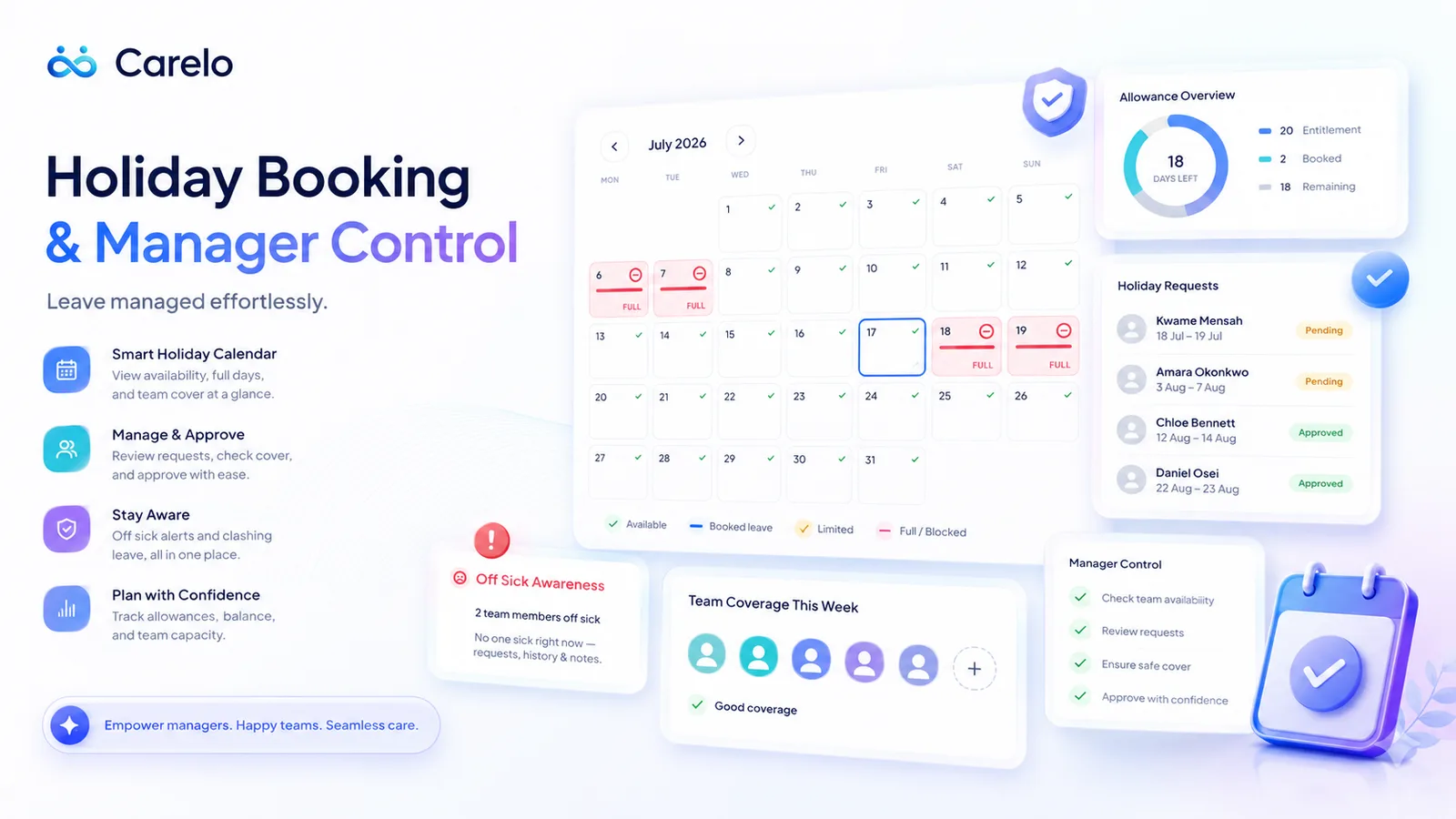
One rota, every PA sees their own calls. Plan the week once. Each carer's Carelo app shows only their calls for your loved one. Change a call and their phone changes with it.
Hours from real check-ins. Carers check in and out at the door. Hours this month per carer come from those stamps, not from memory, and timesheets export for your payroll service.
Holiday with the gap shown. A PA asks for leave in the app. You see the gap it leaves in the rota before you approve, and the approved days come off the rota automatically.
Dates that run out. DBS and right-to-work dates sit on each carer's record, and the Carers page tells you when one is close to expiring.
The care itself. Notes at every call, a medication record dose by dose, and the family app so a brother or sister can see the day happen. It is the same system UK care providers use, built around one person.
Carelo does not run payroll, file with HMRC, or arrange insurance or pensions. It keeps the care record and the hours that your payroll service, your council and your conscience ask for.
You must give a written statement of the main terms on or before the first day. A simple contract that covers hours, pay, holiday, notice and duties satisfies this. Your council's support service will usually provide one.
Councils generally do not allow a direct payment to pay a close relative who lives in the same house, except where the council agrees it is necessary. Relatives who live elsewhere can often be employed. Ask your direct payments team first and get the answer in writing.
They can be employed by each family separately, each running PAYE, or they may be genuinely self-employed if they control their own work. The test is how the work runs, not what suits either of you. HMRC's employment status tool gives a result you can keep.
5.6 weeks a year, pro rata. For a PA on 20 hours a week that is 112 hours a year, building up through the year. Your record of hours worked is what makes the figure defensible.
No. It keeps the rota, check-ins, notes, medication record and hours. The timesheets it produces go to whichever payroll service you use.
£30 a month. Fourteen days free. Set up within one working day.
Start your free trial