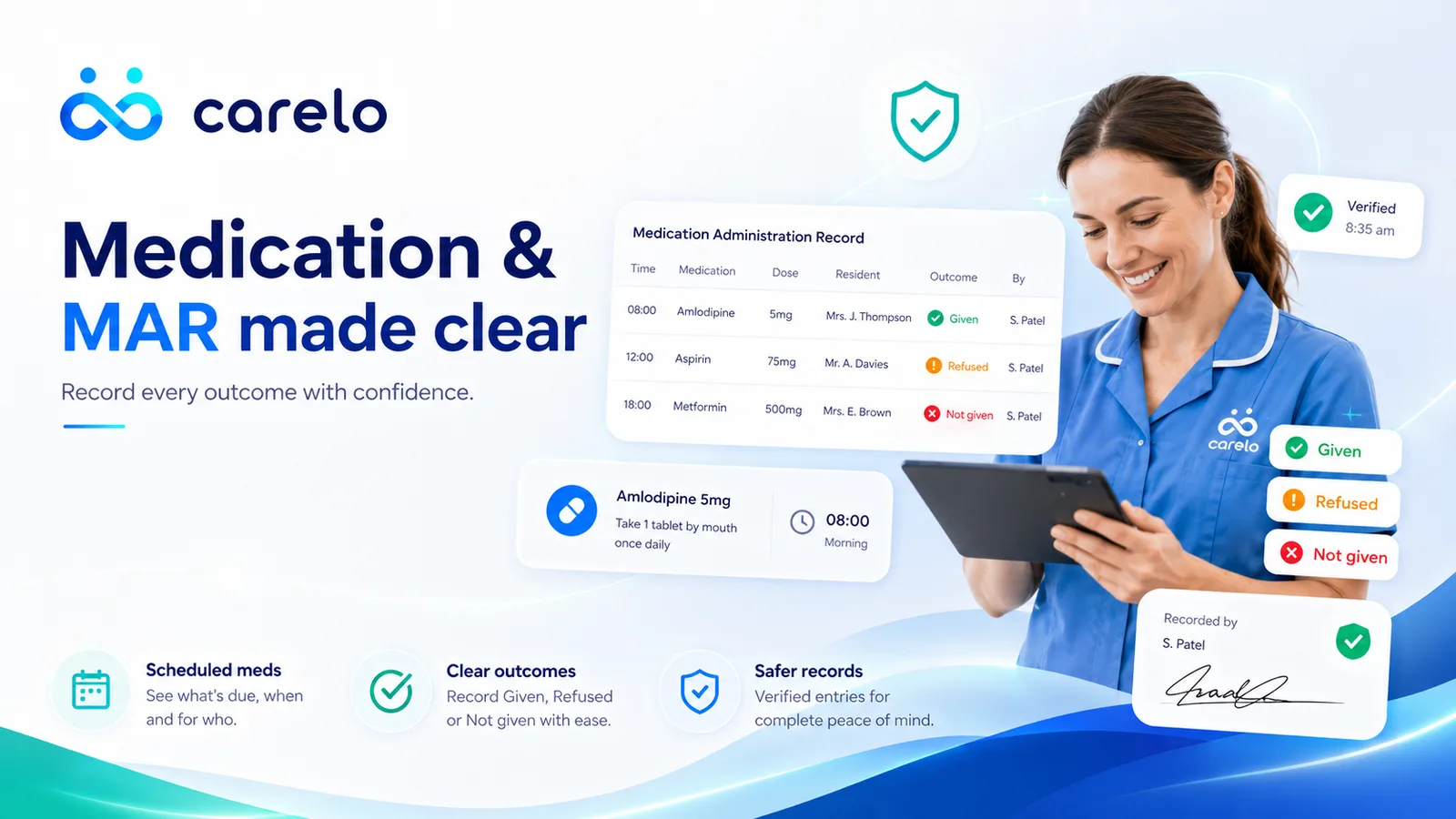
Ask a care provider how they know a tablet was given at eight o'clock on the fourth of the month and they will show you a MAR chart: a medication administration record, one line per medicine, one box per dose, an initial in each box. Families who employ their own carers are expected to reach the same standard, and almost none are told how. This page explains what a MAR chart is, what it has to contain, why paper versions fail at home, and how to keep one that a nurse, a GP or a council would accept.
A medication administration record lists every medicine a person takes with its dose and the times it is due, and records what happened at each of those times: given, prompted, refused, not required, not given, with the initials of the carer who recorded it and a reason where one is needed. It is the single document that lets anyone, at any later date, see what was taken and what was not. GPs, pharmacists, hospital doctors and safeguarding teams all know how to read one.
The level of help matters, because it decides what the carer is responsible for. Prompting is reminding the person to take a medicine they manage themselves. Assisting is helping them do it: opening the packet, handing the tablet, steadying the glass. Administering is the carer giving the medicine, deciding the dose from the chart and the time. Many family packages drift from prompting to administering as a parent's memory fades, without anyone deciding it or writing it down. The chart should say which level applies to each medicine, and the record at each dose should match it.
The paper chart lives in one place, usually a folder in the kitchen. The morning carer initials it. The lunch carer is in a hurry and means to. The evening carer sees an empty box and does not know whether the lunch dose was missed or just unrecorded, so gives it, or does not. The family reads the chart at the weekend and finds a week of gaps. Nobody can say what actually happened. If the person ends up in hospital, the doctor asks what they have taken and the honest answer is that nobody knows.
The chart is also rewritten by hand every month, which is where a dose or a time quietly changes. Pharmacies print charts for providers; families usually photocopy one.
Painkillers, laxatives, inhalers and anything "when needed" are where records go wrong fastest, because there is no fixed time to prompt the carer. Each dose needs the time, the reason and the initials, and the next carer needs to see it so the daily maximum is respected. Refusals matter just as much. A person who refuses a medicine three evenings running is telling you something a GP needs to hear, and a chart that records refused rather than leaving a blank is what makes that visible.
Every medicine, listed once. Name, dose, times and the level of help, entered once and shown to the carer at every call where a dose is due.
Recorded at the dose, on the phone. At each call the carer records each due medicine as given, prompted, not required, refused, not given or other, with a reason where one is needed. There is no box to forget, because the medicines due at that call are shown to the carer on the call itself.
The chart, the same day. You see the MAR chart as it fills, with every carer's initials against every dose. The next carer sees what the last one gave. The family app shows the medication log to a brother or sister who wants to know the evening tablets were taken.
Refusals you can act on. A refused or not-given dose stands out in the record with its reason, so a pattern is seen in days rather than discovered at a hospital bed.
Print it for the GP. Print or export the chart for any month. It is the same record UK care providers keep, so every professional who sees it knows how to read it.
Carelo does not prescribe, dispense or decide doses. It records what trained carers did, exactly as a provider's chart does.
If they administer rather than prompt, yes. Councils and local training providers run medication courses for personal assistants, and many councils will fund them from the direct payment. The chart records what was done; training decides whether the carer should be doing it.
Yes. Enter each medicine as it appears on the label or the repeat prescription: name, strength, dose and times. Keep the repeat slip as the source and update the chart whenever it changes.
The record shows the time it was actually recorded, not the time it was due, so a late dose is visible rather than hidden. That is what makes the record trustworthy.
Yes. A family member can be set up as a carer on the household and record doses the same way, with their own initials.
The medication record is part of the Personal plan: £30 a month per household, or £288 a year with 20% off. Fourteen days free, no VAT added, cancel any time.
£30 a month. Fourteen days free. Set up within one working day.
Start your free trial