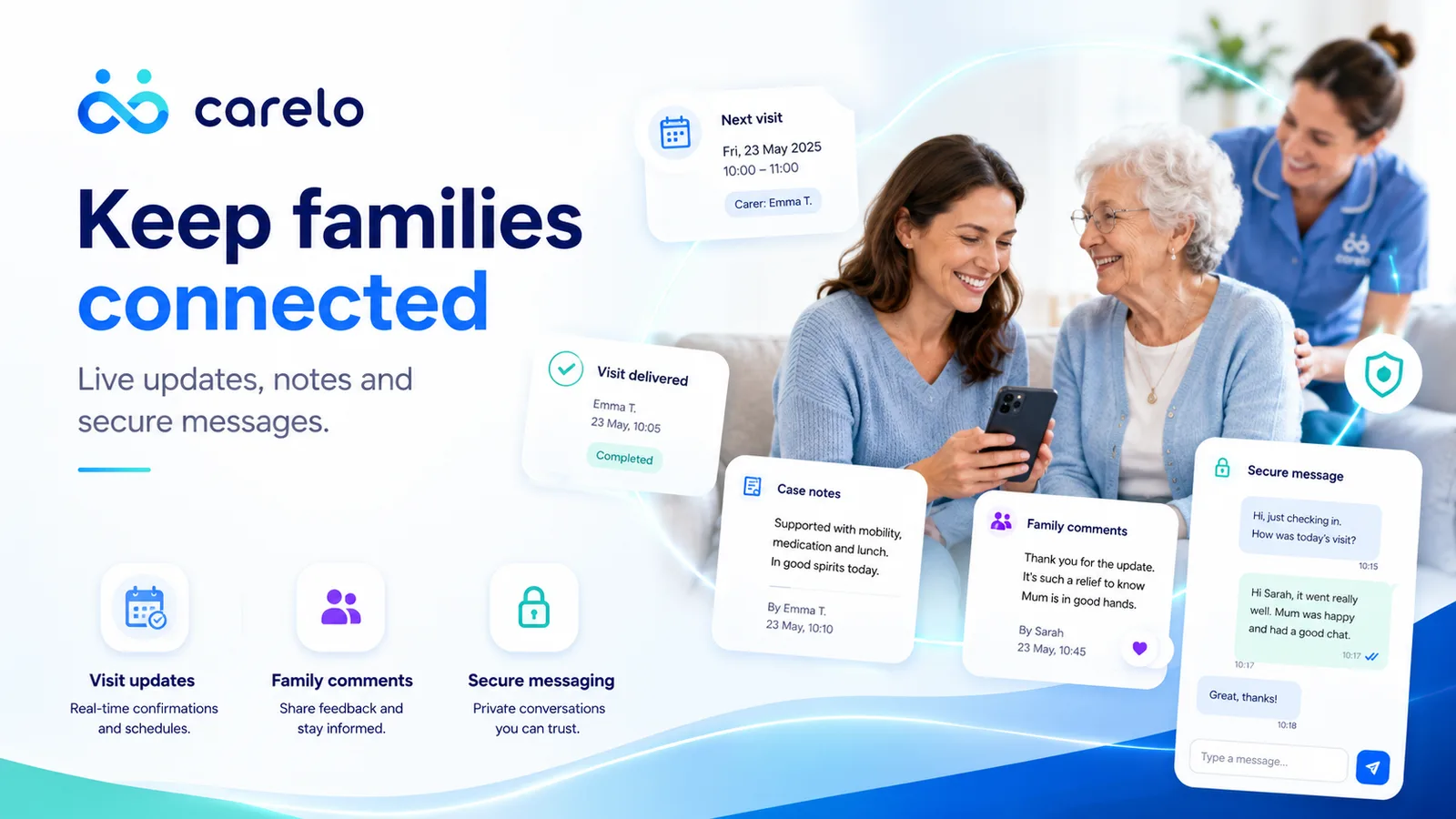
When a parent has dementia, the people caring for them cannot rely on the parent to say what happened. Did she eat lunch? Did she take the evening tablets? Was the carer there this morning? Was she upset again, and why? The only honest answers come from a record made at the time by the person who was there. This page is about what that record should hold, who needs to see it, and how to keep it without adding to anyone's day.
In most care, the person is the record of last resort: ask them and they will tell you. Dementia removes that. A parent may say she has eaten when she has not, that nobody came when the carer left ten minutes ago, that she took her tablets when they are still in the blister pack. None of this is deliberate. It means the carers' record is the only record, and gaps in it are gaps in the truth.
Dementia also changes. A medicine stops working, a new behaviour appears, nights become disturbed. Clinicians make decisions on patterns over weeks, and patterns are invisible without a record made daily.
People with dementia do better with familiar carers and a steady routine. That argues for a small team and a weekly pattern that rarely changes, which is exactly what a direct payment lets a family build. It also means that when a carer is away, the replacement must be able to pick up the routine from the record: the order things are done, the words that calm, the things that upset. A good record is the routine, written down by the people who know it.
At a review, the questions are always the same. How is she sleeping? Is she eating? Is she taking the medication? Has anything changed? Any falls? A family answering from memory gives impressions. A family with a record gives dates and patterns: refused the evening dose on nine of the last fourteen days; two falls in the last month, both in the early evening; eating well at lunch, little at tea. Decisions about medication, about more support, about whether home is still safe, are made on exactly that evidence.
Dementia care usually falls to one child, with others wanting to help and not knowing how. The one at the sharp end spends evenings relaying the day to brothers and sisters. The ones at a distance feel shut out or, worse, suspicious that things are being kept from them. A shared record ends both. Everyone sees the same day, as it happens, and conversations turn from "what happened?" to "what shall we do?".
A small team on a steady pattern. Set the week's calls once with the carer who normally does each. The pattern repeats; changes are made only on the week they happen. Each carer's Carelo app shows their own calls.
Notes at every call, in the carer's words. Food, mood, sleep, safety, anything to watch, written before the carer checks out. The next carer reads it before they arrive. The diary holds every note ever written about your parent and can be read by date.
Medication with refusals visible. Every dose recorded as given, prompted, refused, not required or not given with a reason. A run of refusals is seen in days, with the dates to show the GP.
Check-ins you can trust. The carer checks in at the door with the time and the location, so "nobody came this morning" can be answered kindly and truthfully.
Everyone sees the same day. Brothers and sisters open the family app and see today's calls as they happen, every note and the medication log, and can message the household. The first family login is included; extra logins are £10 a month each, up to five.
Print it for the clinic. Export or print any period: the visits, the notes, the MAR chart.
The note takes under a minute at the end of a call and can be written in the hall or the car. Most carers find it less intrusive than a paper folder opened on the kitchen table.
Yes, every carer on the household reads the diary before their call. That is what keeps the routine steady when faces change.
Not a login, but you can print or export any period and take it to the appointment, or show the record on your phone.
Agency carers can be added to the household as carers if the agency agrees, and then check in and write notes like anyone else. Calls the agency keeps on its own system stay on its system.
£30 a month per household, or £288 a year with 20% off, including the carer app and the family app. Fourteen days free, no VAT added, cancel any time.
£30 a month. Fourteen days free. Set up within one working day.
Start your free trial