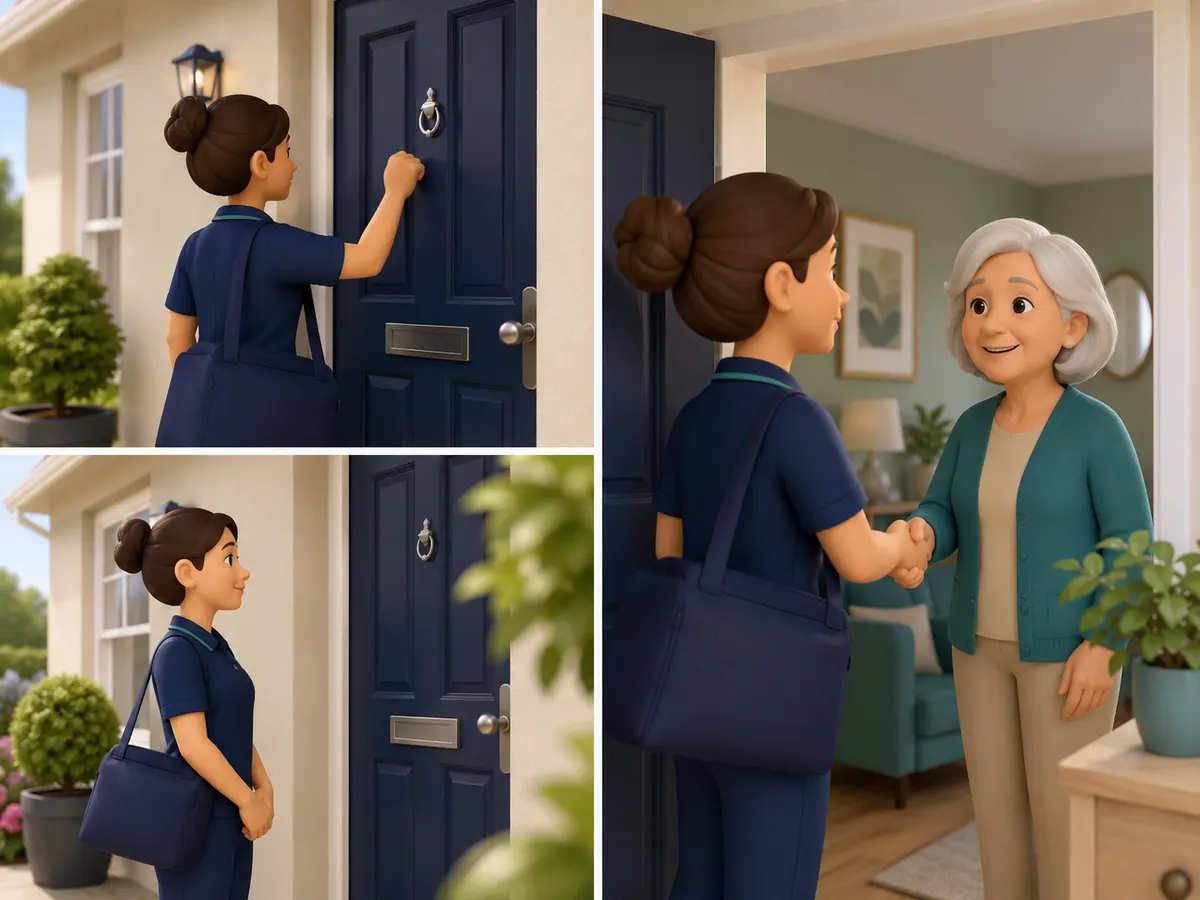
From a short visiting call to full-time live-in support — the many shapes home care takes, and the people who deliver it.
Home care is not one single service delivered the same way to everyone. It ranges from a thirty-minute visit to help someone get up in the morning, right through to a carer living in the house full-time — and understanding the different types helps explain why the job can look so different from one carer's day to the next.
| Type of care | What it offers |
|---|---|
| Visiting / domiciliary care | Short, scheduled calls through the day for help with washing, dressing, meals and medication |
| Live-in care | A carer lives in the home full-time, offering support and reassurance around the clock |
| Complex or clinical care | Specially trained carers support conditions such as tracheostomy, PEG feeding or epilepsy, often alongside nurses |
| Respite care | Short-term care that gives a family carer a proper break, from a few hours to a couple of weeks |
| Reablement | Short, intensive support after a hospital stay or setback, aimed at rebuilding independence |
| End-of-life care | Comfort-focused support in a person's final weeks or days, usually alongside district nurses or a hospice team |
Companionship runs as a thread through almost all of these rather than standing apart as its own category — even a task-focused visit should carry warmth and real conversation within it, and some calls are built almost entirely around company, conversation and getting out of the house rather than any physical task at all.
It is worth being clear that none of these types is a lesser or lower-skilled version of another. A visiting carer managing four or five different clients in a single morning needs sharp organisation and the ability to switch gears completely between houses; a live-in carer needs the stamina and emotional resilience to build a life alongside someone day after day; complex care demands genuine clinical competence that has to be formally assessed and signed off before a carer is allowed to deliver it unsupervised. The right type of care, for the right person, is simply whichever one matches their actual needs — nothing more, nothing less.
Visiting care — sometimes just called domiciliary care — is by far the most common form of home care, and it works around a simple rhythm: a carer arrives at a scheduled time, completes the tasks set out in the care plan, and moves on to the next call. A single client might have one visit a day or several, depending on what they need.
Because each visit is relatively short, the opening moments matter enormously. A calm, unhurried greeting sets the tone for the whole call, and it is also the moment a carer often notices, without even trying, whether something about the person seems different today.
Home care is delivered by a whole team of people, each with a distinct role, and most carers build a career by moving steadily through these roles over time rather than staying in exactly the same job for years.
The foundation of the whole profession — visiting clients directly, delivering personal care, and building the trust everything else depends on.
Takes on extra responsibility such as medication competency, mentoring newer carers, and handling more complex calls.
Works behind the scenes building the rota, matching carers to clients, and carrying out spot checks to keep quality consistent.
The person legally responsible for the service to CQC or CIW, overseeing every carer, every care plan and every standard the company holds itself to.
Progressing through these roles usually means building on the mandatory Care Certificate with recognised qualifications such as an NVQ or QCF diploma in health and social care, alongside years of practical experience that no classroom can substitute for. A registered manager, for instance, has almost always spent real time as a carer and a supervisor first — the career ladder in this sector is built from the ground up, not skipped.
This matters for anyone starting out who wonders where the job can actually lead. Care work is sometimes talked about as if it has a low ceiling, but the truth is closer to the opposite — a genuinely reliable, capable carer who keeps learning has a clear, well-worn path in front of them, through senior roles, into supervision, coordination or training, and eventually, for those who want it, into full management of a service.
Whichever role a carer holds, the working day begins the same way: properly prepared. A stocked, checked bag — gloves in the right sizes, hand sanitiser, aprons, anything else the day's calls require — means nothing has to be scrambled for once a visit is under way.
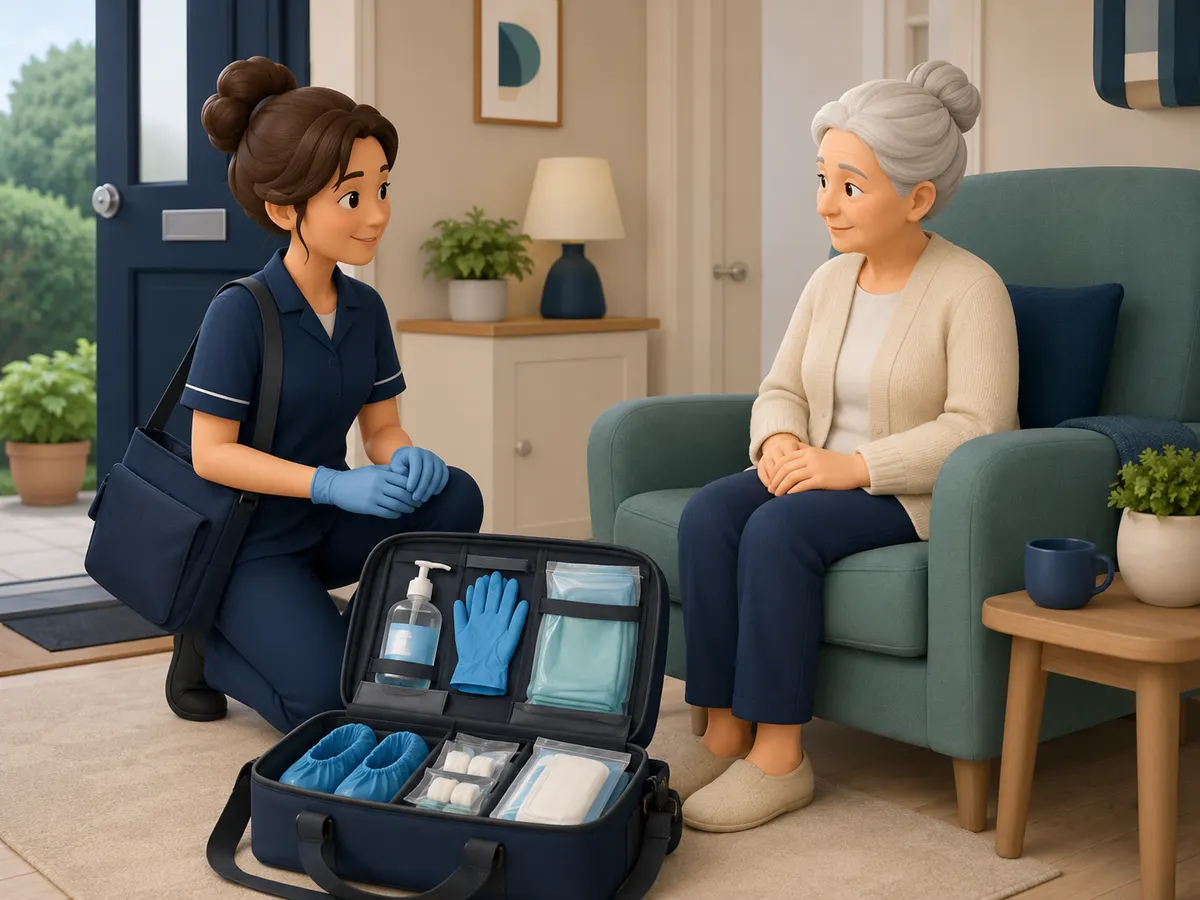
This kind of preparation rarely gets noticed when it's done well — which is exactly the point. It only becomes visible on the rare day it's missing, and by then it's too late to matter.
Some visits are written into the care plan as a 'double-up' or 'double-handed' call, meaning two carers attend together rather than one. This is usually a moving and handling decision — a person may need two people to transfer safely from bed to chair, for example — but it can also reflect the level of personal care needed, or a risk that simply isn't safe to manage alone.
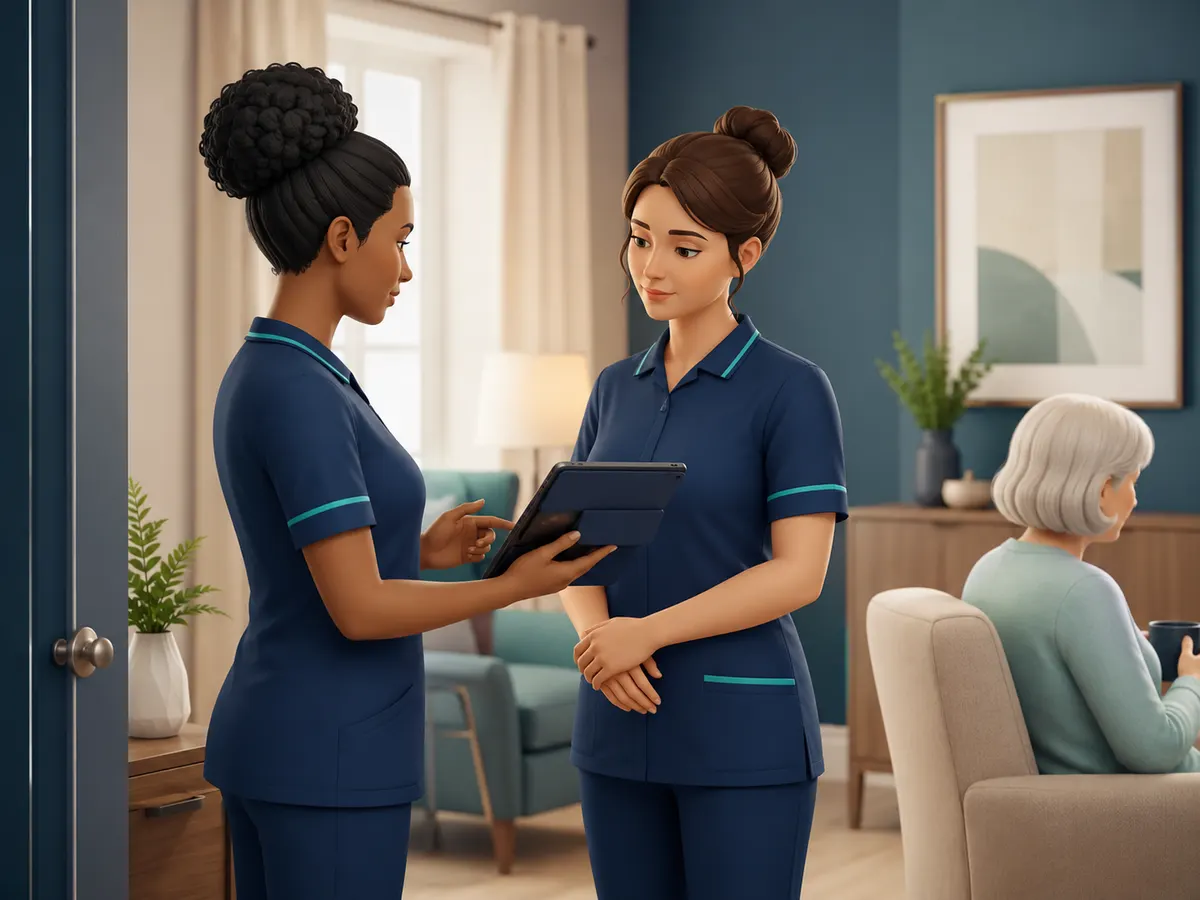
Working a double-up call well means clear, quiet communication between the two carers throughout — agreeing who leads, checking in with each other before a move, and never assuming the other person is ready. It also means never quietly deciding, on a busy day, to manage a double-up call alone; if the care plan calls for two carers, that is a safety decision that isn't a single carer's to override.
There is a dignity reason for double-up calls too, not just a safety one. Some tasks are simply more comfortable and less anxious for a person when handled smoothly by two practised carers working together, rather than a single carer struggling on their own — the extra pair of hands often means the whole task takes less time and feels far less of an ordeal.
Whatever type of care is being delivered and whatever role someone holds, a few qualities separate a good carer from a genuinely great one.
Turns up on time, every time, because someone's medication, meals or safety may depend on it.
Never rushes a person who needs a moment longer, and treats every visit with warmth rather than routine.
Notices the small changes — a hesitant step, a skipped meal, a quieter mood — before they become bigger problems.
Reports things accurately, admits mistakes quickly, and never quietly covers over something that went wrong.
The best carers are remembered not for a single grand gesture, but for a hundred small, reliable ones.
None of these qualities are fixed traits some people simply have and others don't. Reliability is a habit, patience can be practised, observation sharpens with experience, and honesty is a choice made afresh every single visit. Whatever type of care is being delivered, and whatever stage of the career ladder a carer is on, these four qualities are what clients and families notice and remember far more than any specific task ever completed.
Carelo gives carers the app this handbook was written for: calls, GPS check-in, notes and medication at the door. From £59 a month for agencies; £30 a month for families who employ their own carers.
Book a demo