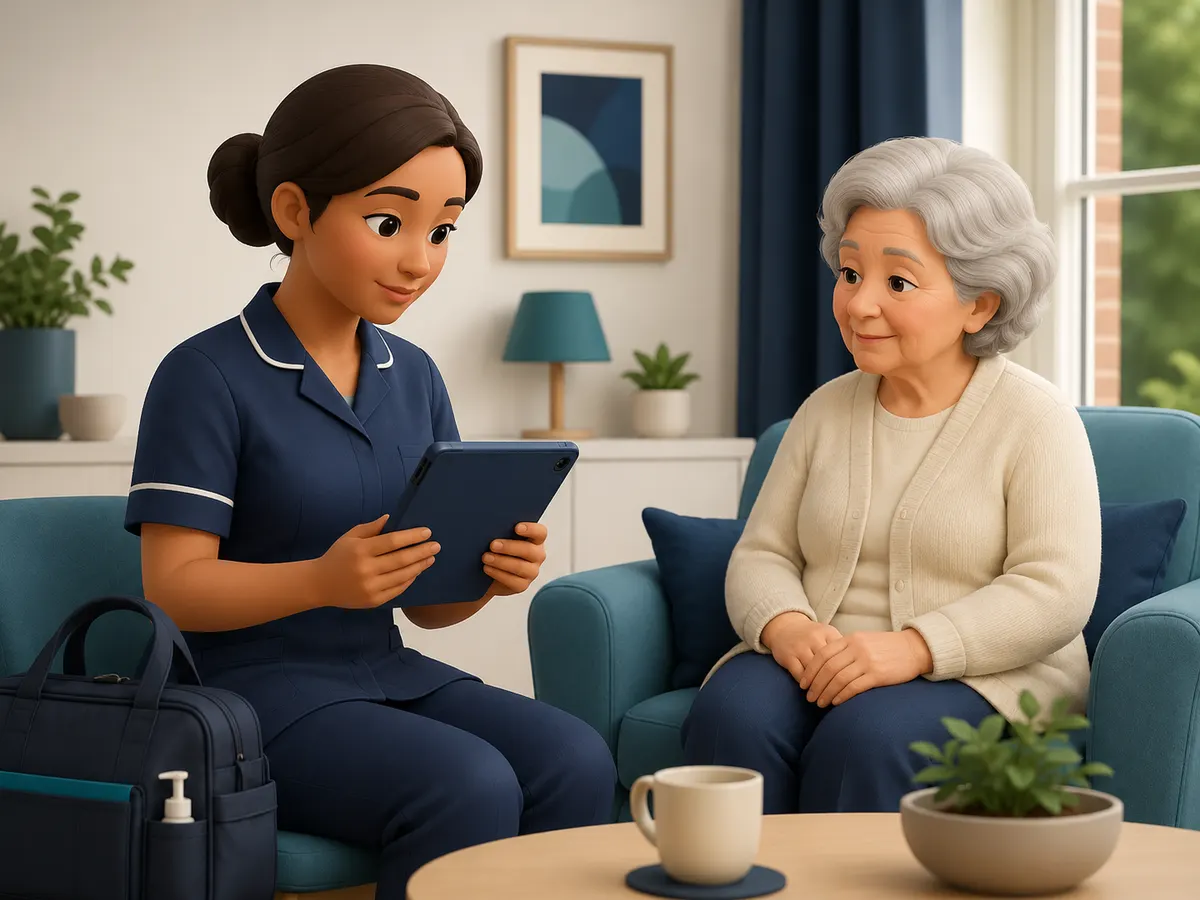
Understanding where home care sits in Britain's wider system of care — and why the work matters more with every passing year.
Domiciliary care — more commonly called home care — means a carer visits a person in their own home to help them with daily life, rather than that person moving somewhere else to be looked after. It can be a short call to help someone get up and dressed in the morning, a visit at lunchtime to prepare a meal, or several calls a day for someone who needs more support. Whatever the shape of it, the defining feature is simple: the care travels to the person, not the other way round.
This is different in a fundamental way from a care home, where a person moves into a residential setting and staff are on site around the clock. Home care instead fits itself around a life that is already happening — the same kitchen, the same bed, the same view from the same window, the same neighbours popping round. For many people, staying in a home they know, surrounded by decades of memory and habit, matters every bit as much as the practical help they receive.
Home care lets a person stay the author of their own day, in the home that is already theirs.
There is no single 'typical' person receiving home care. The service exists to support an enormous range of people, at very different stages of life and for very different reasons, and a good carer learns early on not to make assumptions based on age or first impressions.
The largest group by far — support to stay safe, well and independent in the house or flat they already know, often for years rather than months.
Adults of any age living with a physical or learning disability may use home care to manage daily tasks while keeping hold of a self-directed, independent life.
Consistent faces, familiar routines and gentle reassurance help enormously for someone who finds change and unfamiliarity unsettling.
Support to spend final weeks or days in familiar, comfortable surroundings, working alongside district nurses and hospice teams.
A further group is supported through reablement — a short, intensive period of care that usually follows a hospital stay, an illness or a sudden decline, aimed at rebuilding a person's own abilities rather than replacing them permanently. Once someone can manage safely again, reablement support is reduced and often ends altogether, its job done. It is a good reminder that home care is not always a permanent arrangement — sometimes its whole purpose is to help someone need it less.
Home care in the UK sits inside a wider system, and it helps to understand roughly how the pieces connect, even though the exact detail differs slightly between England, Wales, Scotland and Northern Ireland. A person's need for care is usually identified first — by a GP, a hospital discharge team, a family member, or the person themselves — and from there, funding and support are arranged through one or more of a few main routes.
| Who | What they do |
|---|---|
| Local authority | Assesses eligibility and needs, and funds or part-funds care for people who qualify |
| Self-funders | Arrange and pay for their own care privately, often contracting an agency directly |
| The NHS | Provides medical care and district nursing, and works with local authorities on hospital discharge |
| CQC (England) / CIW (Wales) | Registers, inspects and rates every care provider on the safety and quality of what it delivers |
A local authority needs assessment looks at what a person can and cannot manage safely, and a means test decides how much, if anything, the council contributes towards the cost. Many people instead choose, or need, to fund their own care privately — arranging it directly with a company without going through the council at all. The NHS sits alongside both routes, providing the medical side of things — district nurses, GPs, hospital discharge teams — and increasingly working in partnership with home care providers so that someone leaving hospital has proper support waiting at home rather than an empty flat and a leaflet.
Every registered care provider, whoever is paying, is inspected by a regulator — the Care Quality Commission (CQC) in England, Care Inspectorate Wales (CIW) in Wales, and their equivalents elsewhere in the UK. Inspectors look at whether care is safe, effective, caring, responsive and well-led, and their published ratings are one of the clearest signals a family has when choosing a provider. This is also why the paperwork, the training records and the honest reporting that can feel like background noise on a busy day actually matter enormously — they are the evidence a regulator relies on that good care is really happening.
At the middle of every person's care sits their care plan — a written document that sets out what they need, what they can do for themselves, what they cannot, their preferences, their risks, and exactly how their care should be delivered. It is drawn up with the person (and often their family) before care begins, and it is the single most important document a carer will ever read.
A care plan is never something filled in once and filed away. It is a living record, meant to be checked before a visit and updated whenever something genuinely changes — a new medication, a fall, a change in mobility, a new preference the person has mentioned. Following it closely, rather than working from memory or habit, is what keeps care consistent between different carers visiting the same person across a week.
A carer at the door is the visible part of something much larger happening behind the scenes. A coordinator builds and rebuilds the rota, matching each carer's skills, location and the client's preferences against dozens of calls a day, while leaving realistic travel time so that nobody arrives late or rushed. Field supervisors carry out spot checks and competency reviews, a registered manager holds legal responsibility for the whole service, and an office team handles everything from safeguarding concerns to family phone calls to the endless quiet logistics of covering sickness and holiday.
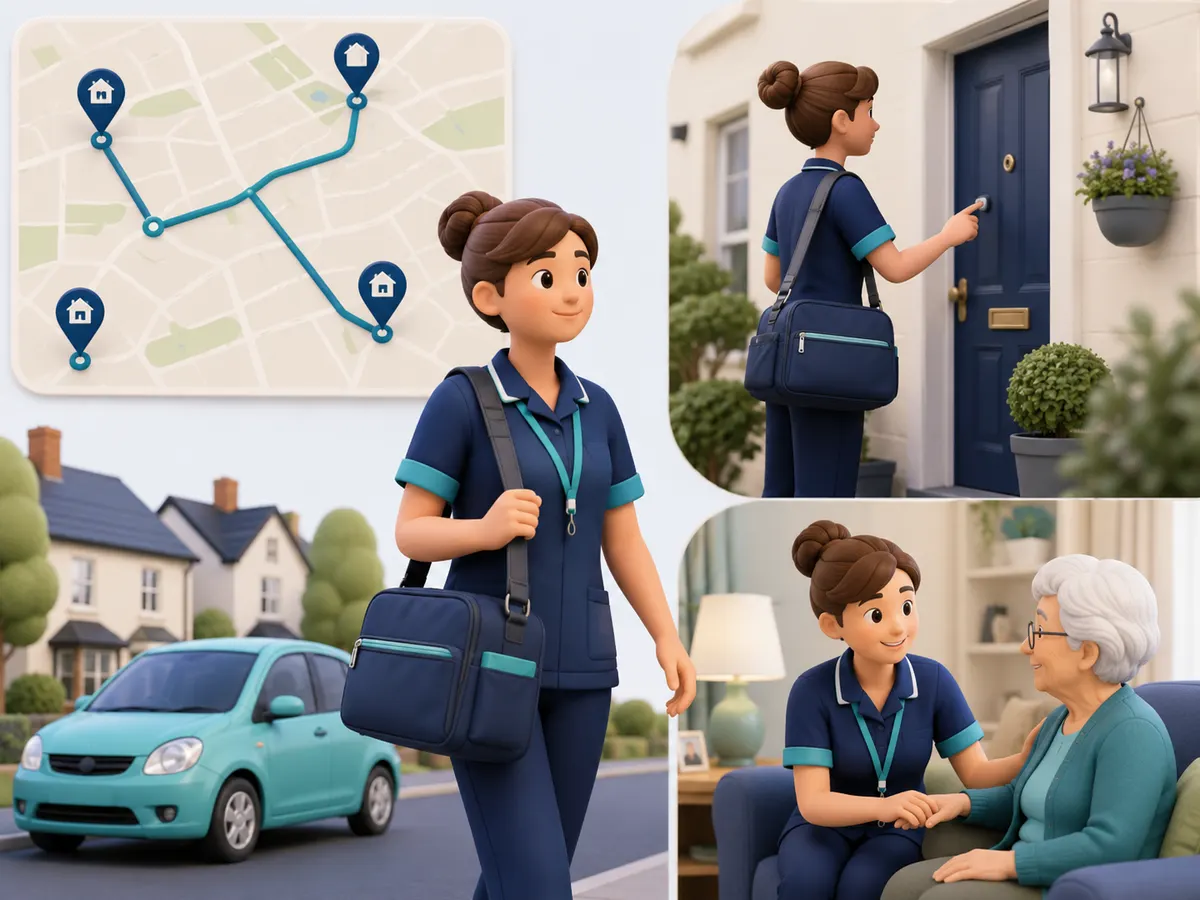
None of this is visible to the person receiving care, and it isn't meant to be — but it is the reason a carer turns up at the right time, with the right information, ready for the right tasks. A well-run office is what turns a collection of individual visits into a genuinely coordinated, joined-up service.
Home care is not a small or shrinking corner of the health and care system — it is one of the fastest-growing parts of it, and the reasons are not hard to see. The UK population is ageing steadily, more people are living longer with long-term conditions, and hospitals are under constant pressure to free up beds for people who no longer need to be there. At the same time, most people, given the choice, say plainly that they would rather stay in their own home for as long as possible.
That combination — more older people, more complex needs, and a strong preference to stay at home — is exactly why the demand for skilled, reliable home carers keeps climbing year on year. It is also why the work matters so much: every visit is part of a system quietly trying to keep pace with a country that is changing shape.
Carelo gives carers the app this handbook was written for: calls, GPS check-in, notes and medication at the door. From £59 a month for agencies; £30 a month for families who employ their own carers.
Book a demo