
Protecting people who cannot always protect themselves — by noticing, listening, and knowing exactly who to tell.
Safeguarding means protecting adults at risk from abuse, neglect and harm — and making sure that when something is wrong, the right people find out about it quickly. An adult at risk might be someone living with dementia, a physical disability, a serious illness, or simply the vulnerability that can come with age and depending on others for daily care.
Every carer has a role in safeguarding, whether or not it says so explicitly in a job description. Being in someone's home regularly, often more than family members are able to be, means a carer is frequently the person best placed to notice when something isn't right — and the person a vulnerable adult may choose to tell, if they choose to tell anyone at all.
Safeguarding is not about suspicion or catching people out. It is about paying attention, taking what you see and hear seriously, and always passing it on to people trained to act on it.
You do not have to be certain something is wrong to report it. You only have to have noticed.
Abuse takes several different forms, and not all of them are physical or obvious. Learning to recognise each type — and to take all of them equally seriously — is one of the most important things a carer learns.
| Type of abuse | What it can look like |
|---|---|
| Physical | Unexplained bruises, cuts or injuries; being rough during care; withholding food or medication as punishment |
| Emotional or psychological | Being shouted at, humiliated, ignored, threatened, or made to feel frightened or worthless |
| Financial | Money, property or possessions taken or misused; pressure to change a will; unexplained missing funds |
| Neglect | Being left without food, warmth, medication, hygiene or medical care that's needed |
| Sexual | Any sexual act or contact without full, freely given consent |
| Discriminatory | Being treated unfairly or with hostility because of age, disability, race, religion or any other characteristic |
Becoming withdrawn, anxious or fearful, especially around a particular person, is often noticed before anything else.
Bruising, cuts or injuries with an explanation that doesn't quite fit, or no explanation offered at all.
Unusual coldness, lack of food, unpaid bills piling up, or a general decline in how a home is kept.
Missing possessions, sudden money worries, or a new 'friend' who's unusually involved in someone's finances.
If a client discloses something worrying, or a carer simply notices something that doesn't sit right, the golden rule never changes: notice it, and report it to the office. Never investigate it yourself, however capable or well-intentioned that might feel, and never promise to keep it secret, however much you're asked to.
Listening well is itself the first and most important part of the job. Let the person speak in their own words, without interrupting or steering the conversation, and resist the urge to ask lots of probing questions — that is a job for trained safeguarding professionals, not a carer in the moment. What matters most is that the person feels heard, and that what they have shared is passed on accurately, factually, and the same day.
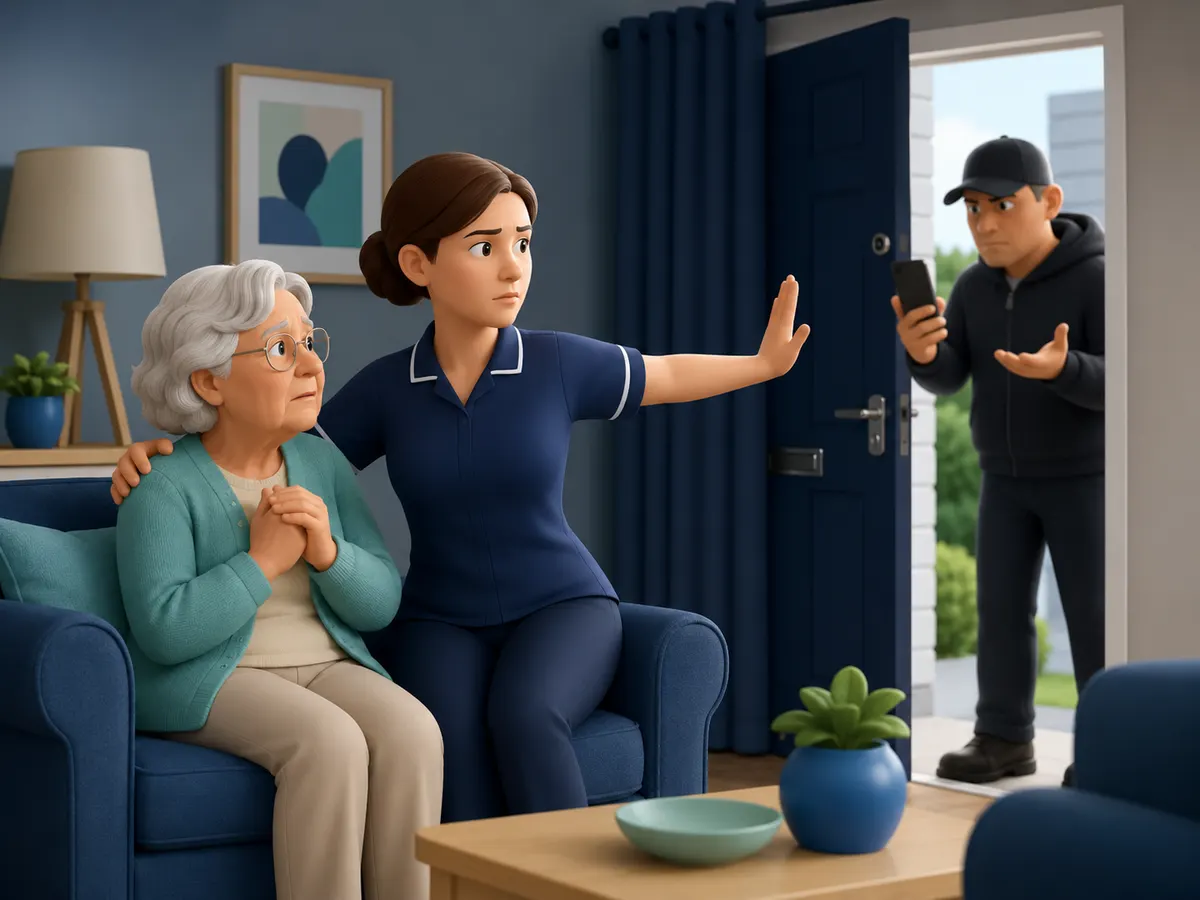
Older people, particularly those living alone, are frequently targeted by doorstep scammers, cold callers and fraudulent traders precisely because they answer their own door. A carer's presence changes that entire picture — not through confrontation, but simply by being there, calm and unhurried, while the door is answered.
Any unexpected caller, however official they sound or look, deserves polite firmness rather than immediate trust. Nothing should ever be signed, agreed to, or paid for on the spot — genuine offers and genuine officials can always wait to be checked. A client should never be left alone with an unfamiliar caller, and whatever happens at the door is reported to the office afterwards, whether or not anything felt wrong at the time.
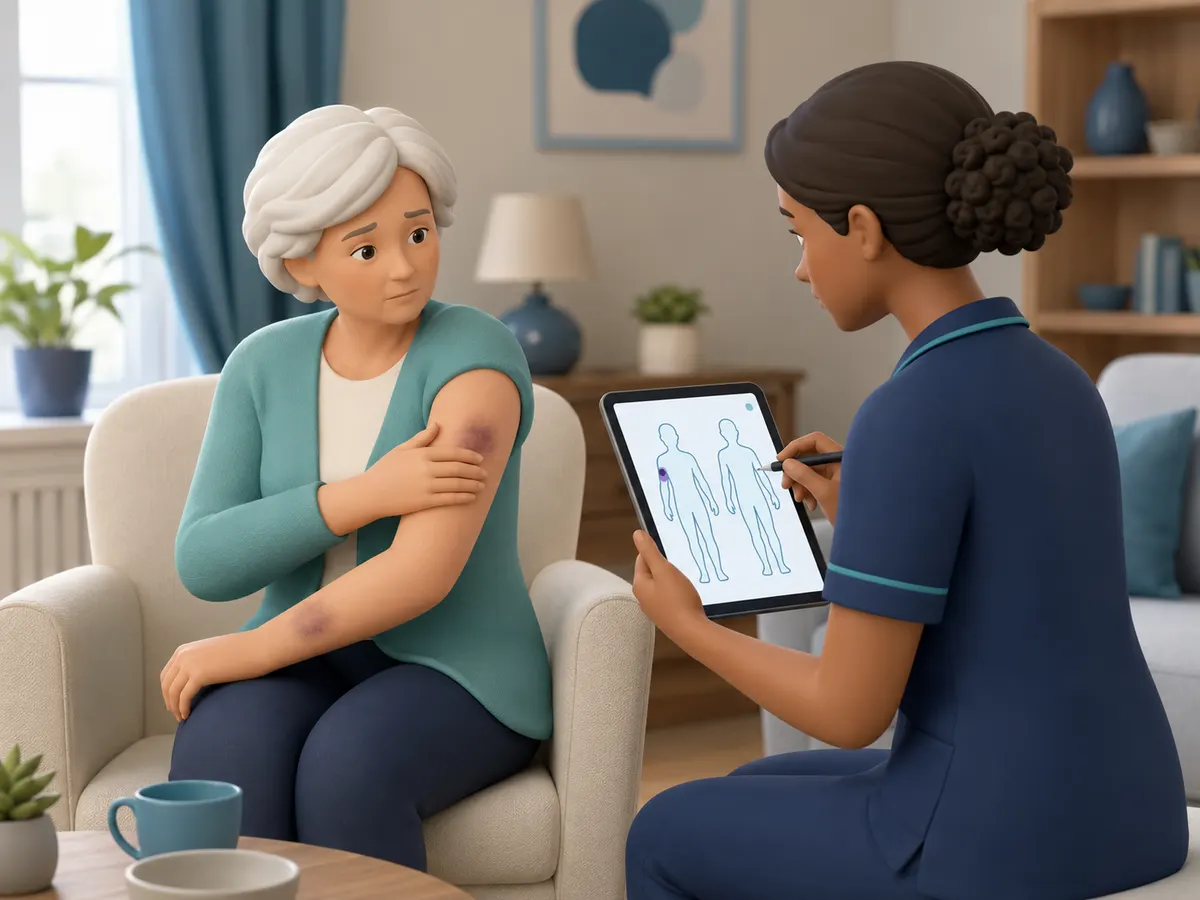
When something is noticed on someone's body — an unexplained bruise, a graze, a mark that doesn't match the story behind it — how it's recorded matters as much as noticing it in the first place. Ask about it once, gently, and accept whatever answer is given without pushing further; a carer's job is to observe and record, never to interrogate or investigate.
Good records are factual and precise: where exactly the mark is, roughly how big, what colour, and the date it was noticed, using the body-mapping tool the service provides. Guesses, assumptions and conclusions have no place in a record like this — only what was actually seen. A well-recorded, unremarkable-looking note taken today can become the piece of evidence that protects someone properly further down the line.
Telecare is the network of simple, connected devices that help keep someone safe between visits, when no carer is physically in the room. None of it replaces a carer — it exists to fill the gaps, and to call for help fast when something happens while nobody else is there.
Worn around the neck or wrist, a single press connects straight to a 24-hour monitoring centre that can call for help immediately.
Some pendants and separate sensors can detect the movement of a fall automatically, even if the wearer can't press the button themselves.
Alert a monitoring centre or family member if a door opens unexpectedly, particularly reassuring for someone who may wander.
Connected smoke alarms notify the monitoring centre directly, so help can be sent even if no one hears the alarm sound.
Behind every pendant alarm sits a monitoring centre, staffed around the clock by trained operators. When it's triggered, an operator speaks to the person through the pendant's speaker, assesses what's needed, and either reassures them, contacts a nominated family member or keyholder, or calls 999 — usually all within moments.
A pendant alarm is only useful if it's actually being worn, within reach, and working. It's worth checking, gently and as part of the normal visit, that the pendant is on rather than left on a bedside table, that the battery indicator looks healthy, and that the person still remembers how and when to use it.
Telecare is a safety net, not a substitute for the relationship, the observation, and the hands-on care a carer provides. A pendant alarm cannot notice a low mood, a subtle change in someone's walking, an unexplained bruise, or a conversation that needs to happen. It cannot make a cup of tea, help someone dress with dignity, or simply sit with them for a while.
Technology can call for help. Only a person can notice that help is needed in the first place.
Carelo gives carers the app this handbook was written for: calls, GPS check-in, notes and medication at the door. From £59 a month for agencies; £30 a month for families who employ their own carers.
Book a demo