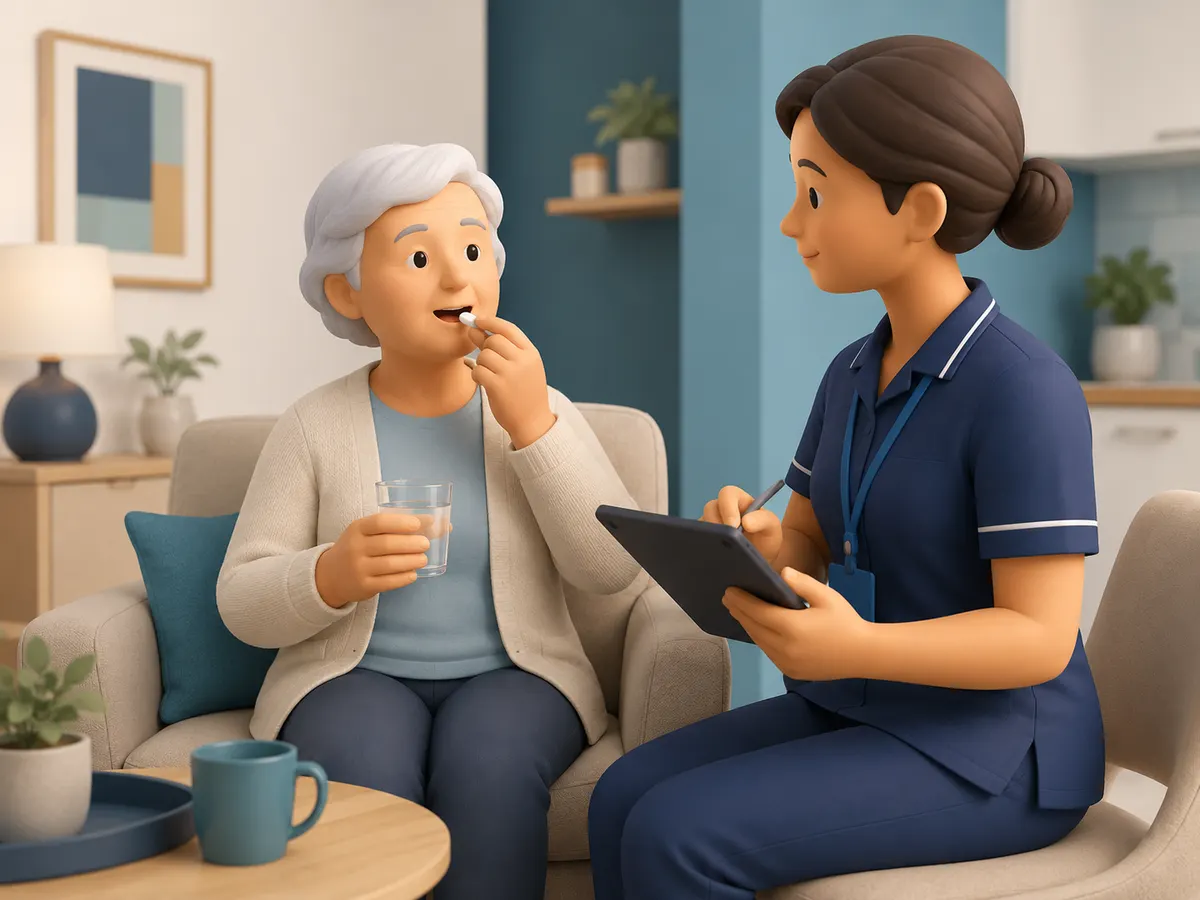
The right medicine, at the right moment, checked and recorded with total honesty.
Medication support is one of the most responsible tasks a carer will ever be asked to do, because the margin for error is almost nothing. A tablet given an hour too early, a dose given twice, or a medicine confused with another person's can cause real and sometimes serious harm to someone who has trusted a carer completely with their care.
Most people receiving home care take more than one medicine, often several, and many only work properly if taken at a particular time, in a particular way, and correctly recorded. This is why medication support is treated with such seriousness across the whole of home care — it is never "just handing over a tablet."
The good news is that the risk is almost entirely managed by following a small number of simple, unbreakable habits, done properly every single time, rather than by any special skill or qualification.
A medicine round isn't finished the moment a tablet leaves your hand — it's finished once it's been swallowed, and written down.
Not every person needs the same kind of help with their medicines, and the care plan will always say exactly which level applies to each person, sometimes to each individual medicine. Understanding the difference between prompting, assisting and administering matters, because each carries a different level of responsibility.
Prompting means simply reminding someone that it's time for their medicine and letting them take it entirely themselves. Assisting means physically helping with part of the task — opening a stiff bottle, steadying a shaking hand — while the person still directs and largely carries it out. Administering means the carer gives the medicine directly, following the chart precisely, because the person cannot manage any part of it alone.
| Level of Support | What It Means |
|---|---|
| Prompting | Reminding someone it's time, then leaving them to manage the whole task themselves |
| Assisting | Helping with part of the task — opening a bottle, steadying a hand — while they do the rest |
| Administering | Giving the medicine directly, following the chart precisely, because the person cannot manage it alone |

MAR stands for Medication Administration Record, and it is the single most important document in medication support. It lists exactly what medicine is due, in what dose, at what time, and by what route — and every time a dose is given, missed or refused, that fact is written on the chart.
A MAR chart is a legal record, not a helpful note. If something ever goes wrong — a reaction, a missed dose, a question from a GP or a family member — the MAR chart shows precisely what happened and when, which is why guessing, back-filling from memory, or leaving gaps is never acceptable.
Checking the chart before every single dose, even for a medicine given a hundred times before, is a habit worth protecting completely. Memory is not reliable enough for a task where the cost of being wrong can be someone's health.

Behind every safe medicine round sits a simple discipline that experienced carers repeat almost without thinking: the right person, the right medicine, the right dose, at the right time, by the right route. Missing any one of these five checks is how errors happen, even to careful, well-meaning carers.
This is not about memorising a slogan — it is about pausing, however briefly, before every single dose, and running through the check properly rather than assuming everything is as it should be because it usually is.
Checked against the care plan and chart every time, even in a home with more than one person receiving support.
Matched against the label and the chart, not assumed from shape, colour or packaging alone.
Exactly what the chart states — never rounded up, rounded down, or estimated.
Given in the window the chart allows, because some medicines depend on steady timing to work properly.
By mouth, on the skin, in the eye — exactly as prescribed, and never substituted for convenience.

Medicine does not only come as a tablet swallowed with water. Patches, eye and ear drops, inhalers, creams and blister packs are all part of a home carer's week, and each has its own small set of rules that matter just as much as the rules for a tablet.
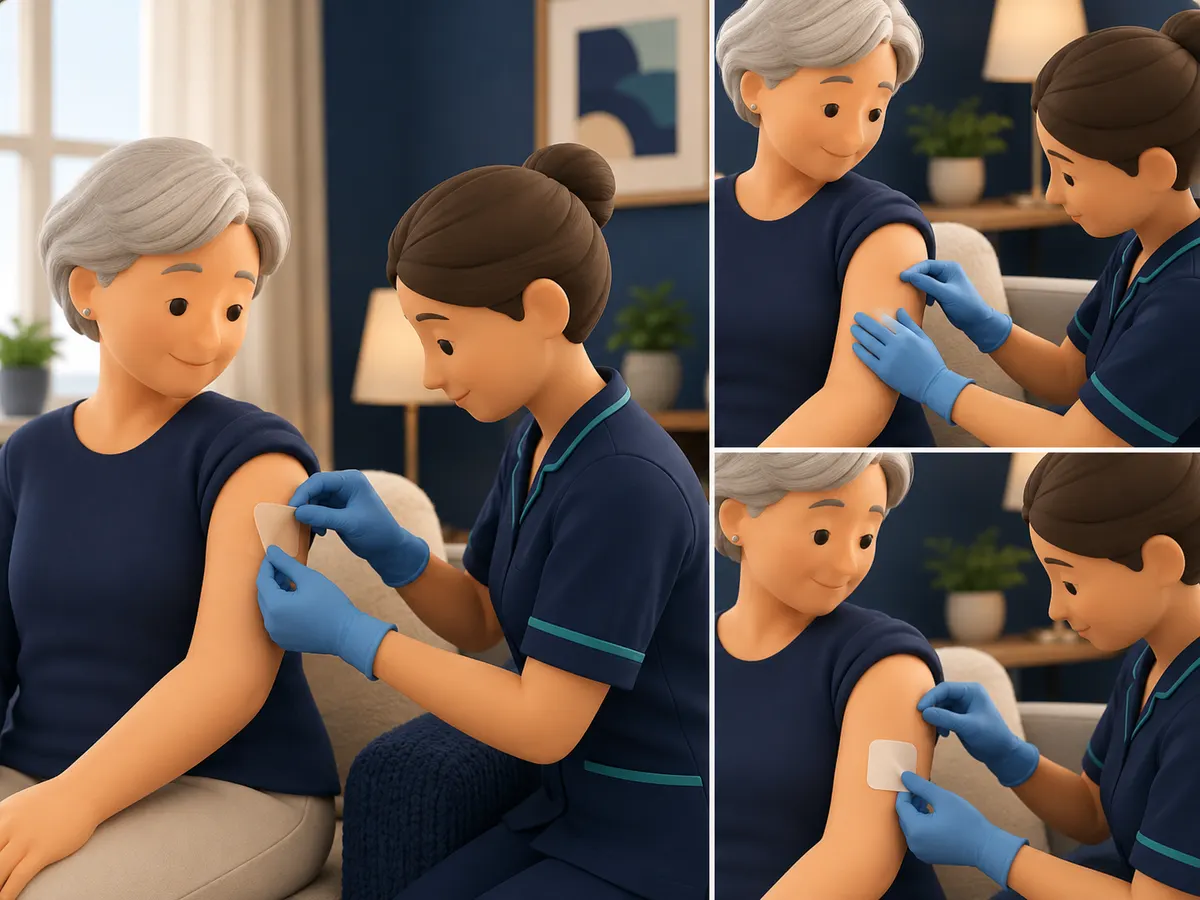
A patch works by releasing medicine steadily through the skin over hours or days, which means where it goes, and how it's handled, genuinely matters. Gloves are worn to apply or remove any patch, since some medicines can pass through a carer's skin just as easily as the skin it's meant for, and the care plan's instruction on rotating the site is followed exactly, since that's what protects the skin from irritation over repeated use.
An inhaler only works if it's timed with a breath, so the carer's role is to support that rhythm — watching, encouraging, reassuring — not to take the device from someone able to use it themselves. A spacer, where the care plan calls for one, is used exactly as prescribed, since it can make a real difference to how much of the dose actually reaches the lungs.

A single drop demands total stillness and total trust, since it's placed somewhere genuinely vulnerable. The dropper never touches the eye or eyelid, kept a short distance above every time, both for comfort and to avoid contaminating the bottle for its next use.

Where a care plan specifies treatment for a particular area of skin, that instruction is followed precisely — the marked area, and nowhere beyond it. Gloves protect both carer and client, and any change in the treated area since the last visit, better or worse, is worth recording, since it's often the clearest sign of whether the treatment is working.

Long before a tablet reaches a hand, its safety has already been decided by how it was stored. A medicine cabinet that is locked, organised and honest about what it holds is one of the quietest but most important parts of good medication support.
Every medicine stays in its original, labelled packaging right up until the moment it is given — nothing is ever decanted into an unlabelled pot for convenience, however tidy that might look. A locked cabinet protects everyone in the household, not just the person the medicines belong to, and keeping shelves organised by type or time of day makes it obvious at a glance if something is missing.
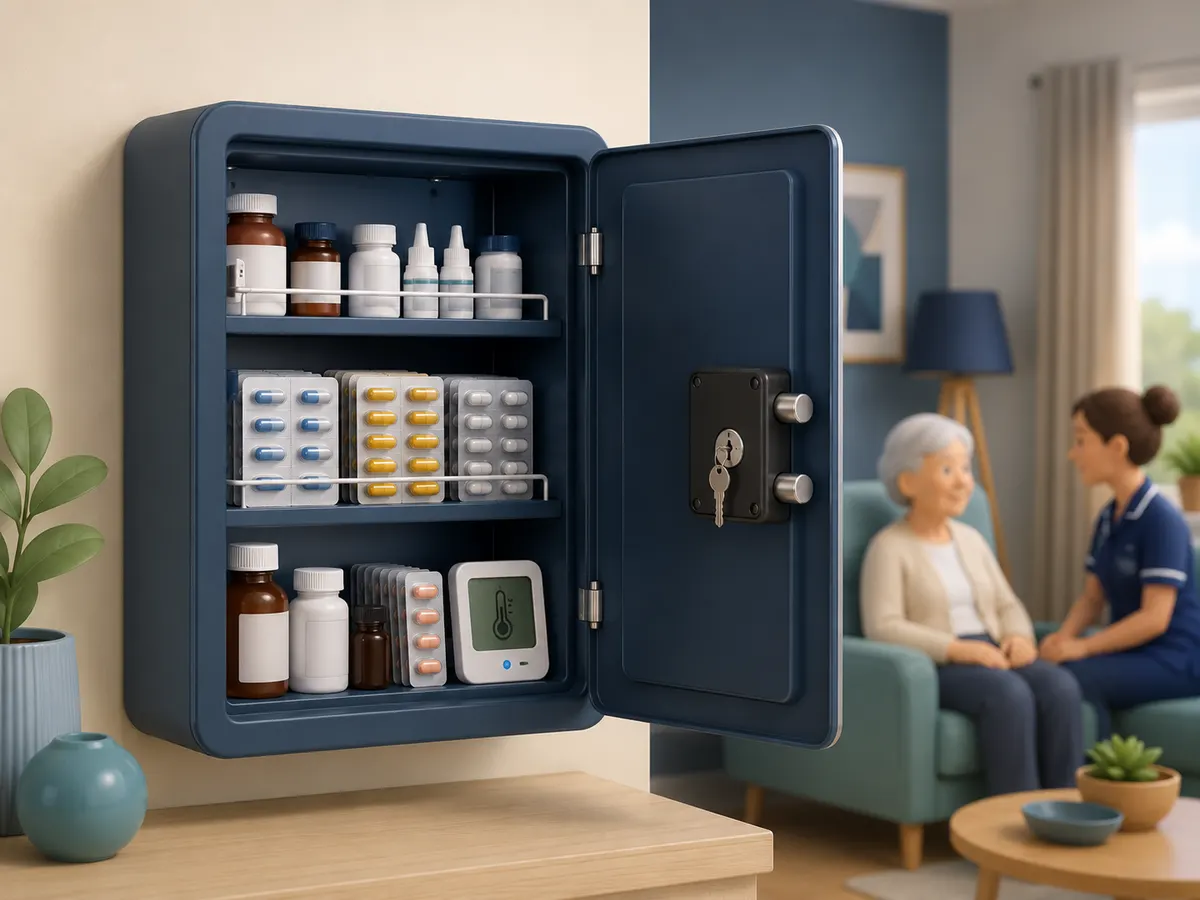
Kept in a locked cabinet or box, out of casual reach, protecting everyone in the household.
Every medicine stays labelled and in its original container — never decanted for convenience.
Sorted by type or time of day, so anything missing or out of place is obvious at a glance.
Every dose is recorded at the time it happens, not at the end of a visit and not from memory afterwards. Whether a medicine was taken, refused or delayed, the record says so plainly and honestly.
A refusal is one of the most important things a carer will ever record, and it must never be left blank. A blank space could mean the medicine was given, missed by accident, or genuinely refused — three very different situations that all need a different response, and a gap in the record makes that impossible for anyone reading it later to know.
If a dose is refused, that is written down exactly as it happened, without pressure applied to change the person's mind and without any guess made about the reason. The office is told, because a pattern of refusal — not just a single instance — can matter enormously to a GP or a family member trying to understand someone's care.
Certain lines are never crossed in medication support, whatever the circumstance, because they sit outside what a carer is trained, qualified or permitted to do.
Doses are exactly what the chart says — never adjusted, rounded, or guessed, even with good intentions.
Medicine is never hidden in food or drink without an explicit, documented instruction from a prescriber.
A medicine belongs to one person only — it is never used for, or borrowed from, anyone else.
Questions about doses, side effects or interactions go to the GP, pharmacist or office — never answered by the carer.
A missing dose, an unfamiliar pack, or a count that simply doesn't add up is never resolved by guesswork, and it is never quietly adjusted or ignored. The medicine is secured, and the office is called the same day — not left until the next scheduled visit — because a genuine problem caught early can usually be put right quickly and safely.
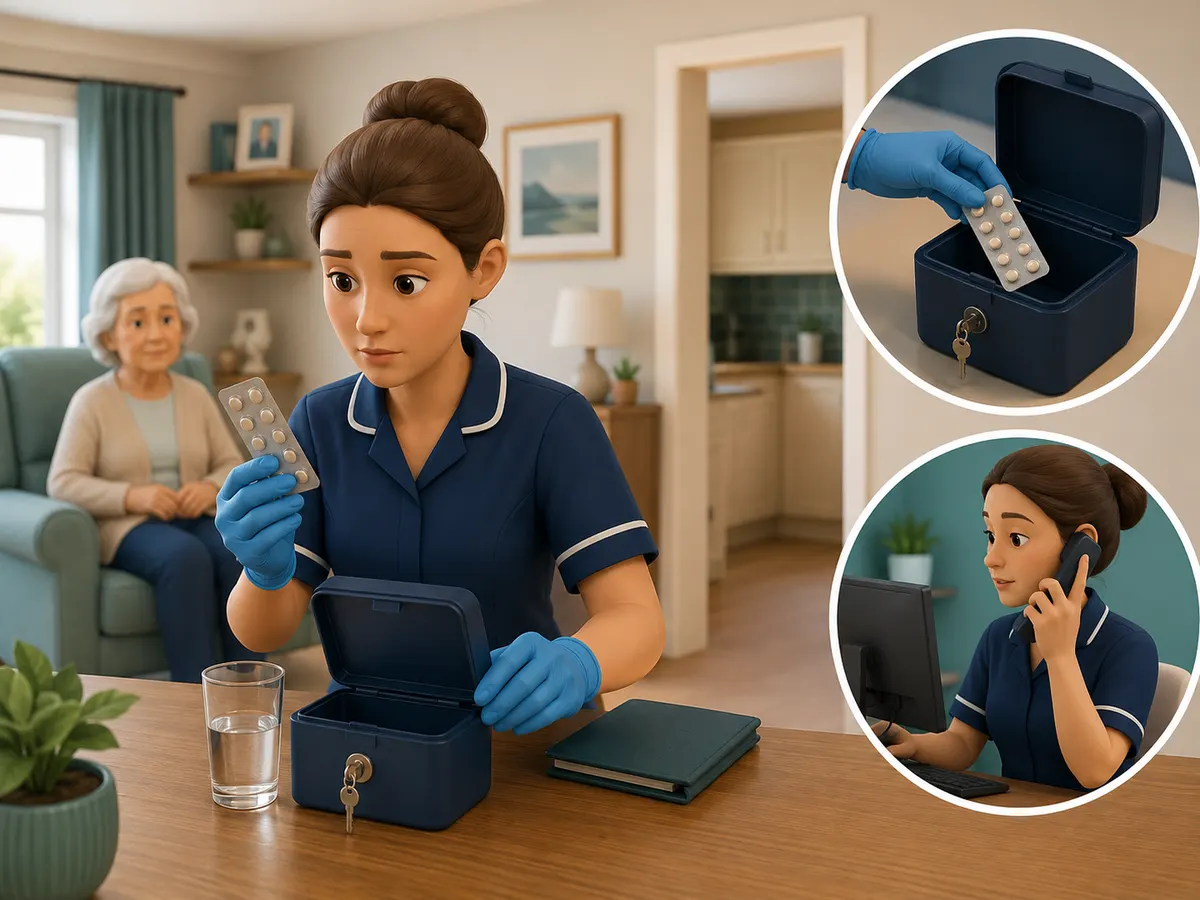
Noticing something's wrong is only useful if it's said out loud, to the right person, the same day.
Carelo gives carers the app this handbook was written for: calls, GPS check-in, notes and medication at the door. From £59 a month for agencies; £30 a month for families who employ their own carers.
Book a demo