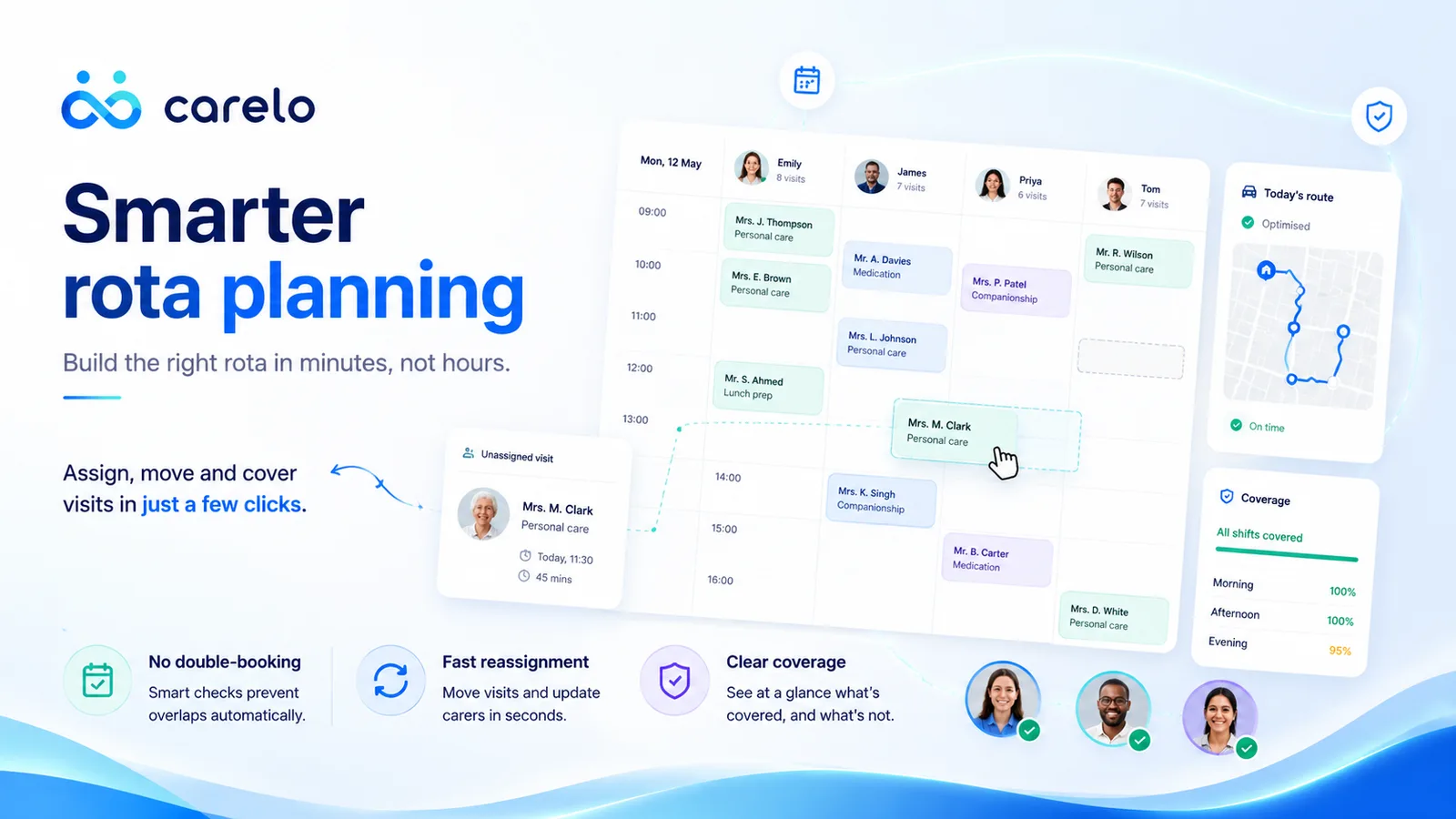
One carer is easy: they come when they come. The moment there are two or three, with a morning call, a lunch call, a tea call and a bed call every day of the week, the family becomes a scheduler. Holidays, sickness, a carer who cannot do Thursdays, a hospital appointment on Tuesday: the week has to be rebuilt and everyone told. Most families run this in a group chat and a kitchen calendar. This page is about running it properly, the way care providers do, without it becoming a job.
A group chat is a conversation, not a plan. The week's calls are somewhere in last Sunday's messages, amended on Wednesday, with a swap agreed between two carers that the family never saw. On Saturday morning nobody comes, because each carer thought the other had it. Or two come, and both expect to be paid.
The record is just as bad as the plan. When the council asks who covered the Tuesday tea call in March, the answer is a scroll through four months of messages. Providers stopped working this way long ago; families were never given the tools.
Almost every care package is a weekly pattern: the same calls at the same times, with the same preferred carer. Write that pattern down once, as a schedule, and let the weeks be made from it. Then the only decisions each week are the exceptions. A rota that is rebuilt from scratch every Sunday is a rota that will be wrong by Wednesday.
A good pattern names, for each call, the time, how long it is, what it is for, and who normally does it. For a parent with four calls a day and three carers, that is twenty-eight lines, written once.
Holidays are the easy case because they are known in advance. The rule that saves families most pain is: approve the holiday only after you can see the gap it leaves, and fill the gap before the holiday starts, not during it. Sickness is the hard case. A text at 6:40am means a morning call in two hours with nobody to do it. The families that cope have a short list of who can be asked, and a rota that shows at a glance which calls are now uncovered.
Either way, the person on holiday or off sick must come off the rota for those days, or the record will later say they worked. Councils notice that.
Some calls need two carers: a hoist transfer, a bath, a person who becomes distressed. Plan those as one call with two people on it, so both know, both come, and both are paid. The opposite problem is the accidental overlap: two carers booked on different calls at the same time, or a carer booked on your parent's call while already on another family's. A rota that cannot see the clash will let it happen.
A plan nobody has seen is not a plan. Each carer needs to see their own calls, for this week and next, on something they carry, and to see changes as soon as they are made. A printed rota on the fridge is out of date the first time it changes. A message in the group chat is read by some. The provider answer is an app on the carer's phone that shows only their calls and updates itself.
The schedule is the pattern. Enter your loved one's weekly calls once, with the carer who normally does each. The weeks ahead are built from it. Change the pattern and every future week changes with it; change one week and only that week changes.
Each carer sees their own calls. Every carer's Carelo app shows only their calls for your loved one, for this week and the weeks ahead. Move a call and their phone shows the new time.
Holiday with the gap shown. A carer asks for leave in the app. Before you approve, you see the calls it leaves uncovered. Approved leave takes the carer off those days automatically, and the uncovered calls are plain to see so you can place someone else.
Double-ups built in. Plan a call with two carers on it. Both see it, both check in, both are paid for their own time.
No double booking. A carer cannot be placed on two calls at the same time. If you move a carer onto a call that clashes with another of theirs, the other call is set aside for cover rather than silently left with two people on it.
A late call shows while it is happening. If a carer has not checked in by the planned time, your home page says so, with the carer's name and the call, so the problem is a phone call at 8:05, not a discovery at tea time.
They can ask, and you make the change in the rota so the record is right. A swap agreed in a chat that the rota does not know about is how two people arrive on the same Saturday.
Yes. The pattern is the normal week; the exceptions are edited on the week they happen. Even families whose weeks vary a lot find that three quarters of the calls are the same every week.
Yes. The plan covers up to three loved ones in one household, each with their own calls and record, and the same carers can work across them.
They need an iPhone or Android phone to see their calls and check in. The app is free and runs on almost any phone from the last several years.
£30 a month per household, or £288 a year with 20% off, including the carer app and the family app. Fourteen days free, no VAT added, cancel any time.
£30 a month. Fourteen days free. Set up within one working day.
Start your free trial